Malina Casino complaints and reputation: how to read the evidence
 Available in AU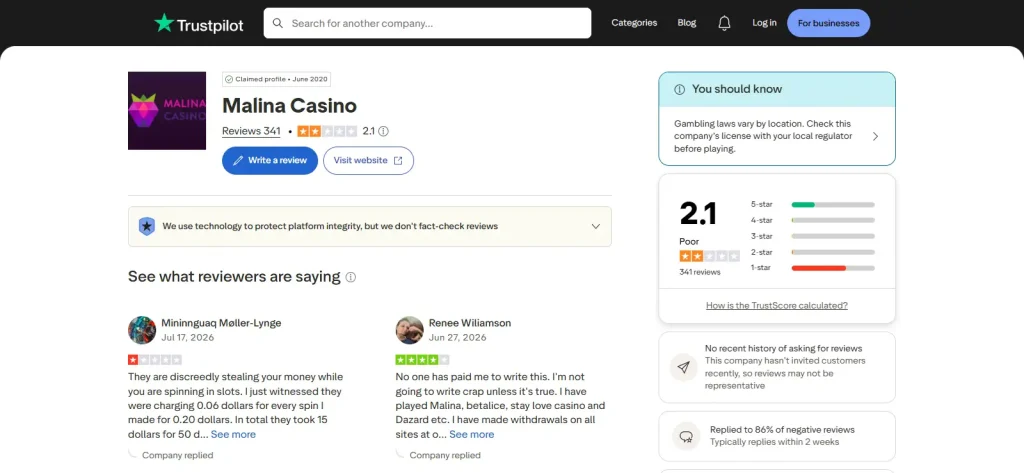
Table of Contents
- A complaint page is more useful when it separates facts, metrics and allegations
- The 2.1/5 Trustpilot score is a dated reputation reading
- Withdrawal delay and account-review themes recur across current complaint databases
- Compare payout anecdotes with the operator's published withdrawal process
- KYC complaints should be tested against what Malina can actually request
- Support availability and support quality are not the same claim
- Regulator-confirmed enforcement should not be blended into user-review allegations
- How to interpret Malina complaints without treating anecdotes as proof
Section element
Complaints and reputation
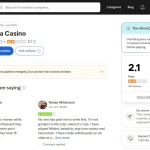
On 21 September 2026, the Trustpilot profile for malinacasino.com showed a 2.1/5 TrustScore from 341 reviews. That is a platform-level reputation signal, not proof that any individual allegation is true or that every player has the same experience. Current complaint databases also contain repeated user submissions about withdrawal delays, verification or account restrictions, but those are anecdotal reports. ACMA’s enforcement and blocking records sit in a different evidence category because they are regulator-confirmed facts rather than customer opinions.
Section element
| Item | Current information |
|---|---|
| Trustpilot | 2.1/5 |
| Reviews at check | 341 |
| Regulator evidence | ACMA action is separate |
| Anecdotes | Not transaction proof |
Three evidence levels
A complaint page is more useful when it separates facts, metrics and allegations
Different sources can be valuable without carrying the same evidentiary weight.
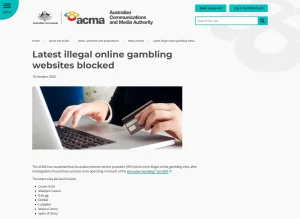
Regulator-confirmed facts sit at the top of the hierarchy for Australian legal and enforcement questions. ACMA has published Malina-specific action, including its 15 October 2025 request for Australian ISPs to block Malina Casino after investigations found the listed services operating in breach of the Interactive Gambling Act 2001. The dedicated Malina legal status in Australia page explains that record in detail.
Platform-level metrics are the next category. A Trustpilot score summarises reviews hosted by one platform at one point in time. It can show sentiment and volume, but the aggregate is dynamic and should always be date-stamped.
Individual reviews and complaint submissions sit in the anecdotal category. They can identify subjects worth checking, such as a delayed withdrawal or a KYC request, but a third-party complaint does not independently prove what happened inside a specific account.
| Evidence type | What it can establish | What it cannot establish by itself |
|---|---|---|
| ACMA and government records | Australian enforcement, licence context and legal framework. | The outcome of one player’s payment or support case. |
| Review-platform aggregate | A dated sentiment metric on that platform. | That every review is representative or independently verified. |
| Individual complaint or review | What a user says happened and which topics recur. | That the allegation is proven or universal. |
Current platform signal
The 2.1/5 Trustpilot score is a dated reputation reading
The number is useful only when the date and source remain attached to it.
On 21 September 2026, the live Trustpilot profile for malinacasino.com displayed a 2.1/5 TrustScore from 341 reviews. Trustpilot also describes reviews as the opinions of individual users. The figure is date-specific rather than a permanent rating for the brand.
A later visit can show a different score or review count because reviews can be added, removed or reweighted. The date therefore matters whenever the 2.1/5 figure is quoted.
The Malina trust and regulation page separates the review score from licensing and enforcement, which are addressed through ACMA records.
Recurring complaint topics
Withdrawal delay and account-review themes recur across current complaint databases
The recurrence is observable; the truth of each underlying allegation still has to be assessed separately.
Current AskGamblers and Casino Guru material contains multiple user submissions centred on delayed or rejected withdrawals, pending payment review, verification questions and account restrictions. Some entries describe long waits, repeated finance-review messages or a new document request appearing around a withdrawal. These are useful pattern signals because similar subjects appear across more than one independent complaint platform.
The correct conclusion is limited: people have submitted complaints about those topics. It is not valid to turn the recurrence into a statement that Malina never pays, always delays withdrawals, deliberately blocks verification or has committed fraud in a particular case. Complaint sites are not the operator’s transaction ledger and do not independently observe every account event.
There are also positive and mixed user reports on review platforms. That variation reinforces the same point: a reputation page should map themes and evidence weight rather than select the most dramatic anecdote as a universal description.
Withdrawal complaints
Compare payout anecdotes with the operator’s published withdrawal process
The strongest way to investigate a delay claim is to compare the account timeline with the current terms that govern review and payment stages.
Malina’s general Terms allow the finance department up to 3 business days to work through a withdrawal request, subject to checks. Separately, the AU-facing material states a 24-hour internal-processing target and then describes additional method-dependent time. These statements should not be collapsed into a guaranteed total payout time.
When a complaint says a withdrawal has been pending for longer than expected, the useful follow-up questions are factual: when was the request made, was verification complete, was the request cancelled or resubmitted, which payment method was used, and what status does the account show? Those questions belong in the Malina payout process, where the different timing stages are kept separate.
A complaint can therefore highlight a discrepancy worth checking without proving why the discrepancy occurred. The operator’s Terms define the published process; an individual account record would be needed to establish what happened in one specific case.
Verification complaints
KYC complaints should be tested against what Malina can actually request
Verification can affect withdrawal progress, but a complaint headline rarely contains the full account history.
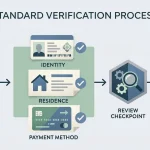
Malina’s current Terms allow identity, age, residence, payment-method and source-of-funds verification. They also state that documents and information are usually reviewed within 10 days after a request has been answered in full, while allowing additional time and checks depending on the circumstances.
This gives a primary-source baseline for reading complaints. A user saying that documents were requested during a withdrawal is not, by itself, evidence that the request was outside the Terms. Equally, the existence of a KYC clause does not prove that every delay was justified or handled correctly. The account-specific request, submission timestamps and operator response would be needed to resolve that.
The Malina verification page lists the document categories and timing wording stated in the current Terms; complaint anecdotes do not establish a universal checklist.
Support evidence
Support availability and support quality are not the same claim
A published channel can be verified even when users disagree about how helpful individual interactions were.
Current Malina material and an independent current review both support 24/7 English live chat as an available support channel. That verifies access to a channel. It does not verify response quality, resolution quality or the outcome of a particular support conversation.
Complaint and review sites contain both criticism and positive comments about support. Those opinions can identify communication as a recurring reputation topic, but they remain user reports rather than established facts about every account. Channel availability is a product fact; satisfaction is an experience judgment.
This matters especially when a complaint involves a withdrawal. A chat agent can explain a status without being the finance department that processes the request. A review describing repeated support messages therefore tells the reader about that person’s reported interaction, not the cause or eventual result of the payment process.
ACMA is a separate layer
Regulator-confirmed enforcement should not be blended into user-review allegations
ACMA evidence is stronger for Australian regulatory status, but it still has a defined scope.
ACMA requested ISP blocking of Malina Casino on 15 October 2025 after investigations found the listed services operating in breach of the Interactive Gambling Act 2001. ACMA enforcement reporting also identifies Stellar Ltd in connection with Malina Casino and describes prohibited and unlicensed service provision.
Those are regulator-confirmed facts. They support statements about Australian enforcement and local licensing context. They do not prove that a named reviewer’s withdrawal was mishandled, that a particular KYC request was improper or that an individual support conversation occurred exactly as described.
Keeping that boundary visible makes the reputation analysis stricter. The site can state the ACMA record directly while still requiring separate evidence for a customer allegation. The Malina Australia guide applies the same rule across bonuses, games, payments and account pages.
A practical reading method
How to interpret Malina complaints without treating anecdotes as proof
Start by identifying what type of source you are reading, then match the claim to the strongest available evidence.
Use ACMA and government material for Australian enforcement, provider law and local licence context. Use current Malina Terms for KYC categories, withdrawal review rules and account procedures. Use Trustpilot, AskGamblers and Casino Guru to see what users are saying and which topics recur, while preserving the difference between a report and an established event.
For a withdrawal complaint, compare the dates and account status with the published finance and verification stages. For a KYC complaint, compare the actual request with the verification categories in the Terms. For support complaints, distinguish whether the issue is channel availability, response time or the substance of the resolution. These checks turn a vague reputation signal into a set of questions that can be investigated.
As of 21 September 2026, the public reputation picture combines a weak Trustpilot aggregate, recurring user-submitted complaint themes and a separate ACMA enforcement record. These elements describe different things and should not be collapsed into a single score.