Malina Casino verification and KYC: what can be required
 Available in AU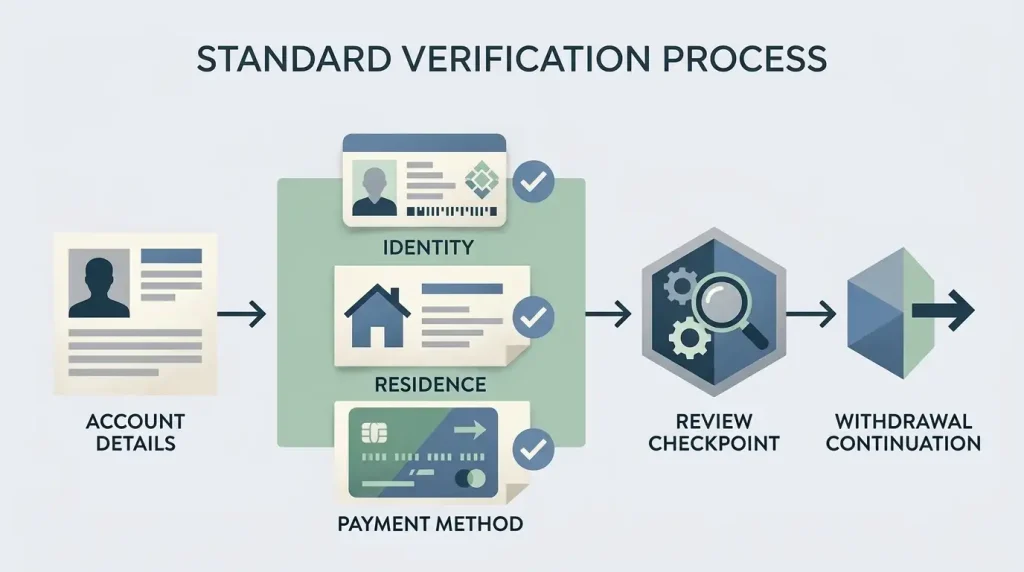
Table of Contents
- Verification is a separate account stage, not part of one fixed signup checklist
- The Terms name four evidence groups without promising a universal document list
- Follow the actual account request rather than a generic KYC checklist
- The current 10-day wording starts after the request has been answered in full
- KYC can pause the payout path without becoming the whole payout timeline
- A verification guide should explain the process without exposing personal documents
- The verification clock depends on the request being answered in full
- What Malina verification can mean for an Australian withdrawal
Section element
Malina KYC – Australia
Malina’s current General Terms allow identity, age, residence, payment-method and source-of-funds checks before or after deposits and around withdrawals. The Terms currently name certified identity evidence, proof of residence, proof of payment-method ownership and relevant transaction histories or statements among the material that can be requested. They also say verification is usually completed within 10 days after a request has been answered in full, while allowing additional time or checks depending on the case. That is a verification window, not a guaranteed withdrawal time, and the exact documents requested can vary by account.
Section element
| Item | Current information |
|---|---|
| Identity checks | Can be requested |
| Residence evidence | Named in current Terms |
| Payment evidence | Ownership and history may be checked |
| Published review wording | Usually within 10 days after full response |
What KYC means here
Verification is a separate account stage, not part of one fixed signup checklist
The current Terms give Malina broad verification rights, but they do not turn every possible request into a universal checklist for every account.
The useful starting point is to separate account creation from later verification. Malina’s current Terms require users to be at least 18 and of the legal gambling age applicable to them. They also allow the operator to verify identity, age, residence and other circumstances using KYC procedures before and after deposits and in connection with withdrawals. In other words, opening an account does not mean every later check has already been completed.
The same distinction appears across the wider Malina account guide. Registration is where account data is created. Verification is where Malina can ask for evidence supporting that data or the ownership and source of money moving through the account. A pending withdrawal can therefore become dependent on verification even if the account has already been used for deposits or play.
Document categories
The Terms name four evidence groups without promising a universal document list
Current primary wording is specific enough to identify the categories, but the list is expressly non-exhaustive.
Identity evidence
The Terms include properly certified identification among information that may be requested.
Residence evidence
Proof of residence is named as a verification category supporting account details.
Payment ownership
Malina may ask for evidence that the payment method used belongs to the account holder.
Transaction history
The Terms also name transaction histories or statements connected with payment methods used.
Account-specific KYC requests
Follow the actual account request rather than a generic KYC checklist
The Terms define what Malina can ask for. The account-specific request defines what is needed in a particular case.
Malina’s Terms do not require every account to submit the same identity document, the same proof of address and the same payment statement at the same moment. They list categories the operator can request, alongside source-of-funds information and additional procedures when required.
For a reader facing a live request, the most reliable sequence is to compare the requested information with the details already recorded on the account, use the official account or support route, and follow the specific request rather than a third-party checklist. The dedicated Malina registration page explains why accurate account data matters earlier in the lifecycle.
Practical preparation does not require guessing which extra documents might be requested. Account details should match the information supplied to the operator, and any requested image or statement should be readable and complete enough for the purpose stated in the request. Identity documents should be sent only through the official verification channel.
Timing
The current 10-day wording starts after the request has been answered in full
Malina’s Terms attach the timing statement to a completed response, then explicitly allow more time or checks where circumstances require them.
The current English General Terms, version 1.12 dated 19 August 2026, say documents and information are usually verified within 10 days after the operator’s request is answered in full. The same clause says additional time and checks can be required depending on the circumstances and complexity of the case.
This wording should not be converted into a guarantee. It does not say that every verification takes 10 days, that approval is automatic at day 10, or that a withdrawal must arrive within 10 days. The timer described in the Terms concerns verification after a complete response. If Malina asks for additional material, the account is still in a verification process rather than a completed payout process.
Withdrawal dependency
KYC can pause the payout path without becoming the whole payout timeline
The verification stage and the finance stage are related but should remain separate when estimating what happens next.
Malina’s Terms reserve the right to withhold payments and to postpone payments until required verification and checks have been completed. They separately allow the financial department up to 3 business days to work through a withdrawal request once the applicable conditions and checks are satisfied. These are two different parts of the process.
That is why the Malina payout process does not add the 10-day verification wording and the 3-business-day finance wording into one guaranteed total. A verification request can introduce its own stage before or during withdrawal review, while the financial-department wording governs a different operational step.
| Stage | What the source supports | What it does not prove |
|---|---|---|
| Verification request | Malina can request identity, residence, payment and source-of-funds evidence. | That every account receives the same checklist. |
| Verification review | Usually within 10 days after a complete response, with extra time possible. | A guaranteed completion date or payout date. |
| Finance review | General Terms allow up to 3 business days for the financial department, subject to conditions and completed checks. | A universal end-to-end withdrawal time. |
Privacy and account safety
A verification guide should explain the process without exposing personal documents
Useful KYC guidance can stay specific without reproducing real IDs, statements, balances or account images.
KYC can involve sensitive identity documents and account-specific upload steps. The exact upload flow, fields and requested documents depend on the live account request, while personal identity documents should be handled only through the official verification channel.
The same rule applies to troubleshooting. The relevant question is whether the official request has been answered accurately and completely, not whether a sample passport, bank statement or card image looks similar to a third-party tutorial. Readers should avoid sharing identity material through unofficial channels or with review sites that are not part of the account-verification process.
If a verification issue becomes part of a broader account or payout complaint, the Malina complaints and reputation page covers public review patterns, while the KYC section covers the current Terms and the account-specific verification process.
Complete response
The verification clock depends on the request being answered in full
The published timing wording only becomes meaningful after the requested information has been supplied completely.
Malina’s Terms connect the usual 10-day verification wording to a request that has been answered in full. That distinction matters when several categories are involved. A request can concern identity, residence, payment-method ownership, transaction history or source of funds, and the Terms say additional checks or time can still be required depending on the case.
For that reason, the most useful progress check is not simply the number of days since the first message. It is whether the current request has been answered completely and whether the operator has asked for anything further. The separate finance-review wording only becomes relevant to the payout path once the applicable verification conditions and other checks have been satisfied.
Practical read
What Malina verification can mean for an Australian withdrawal
The useful conclusion is procedural: identify whether verification is open, answer the actual request, and do not treat published timing as a promise.
For an Australian account, the verification rules themselves come from Malina’s current Terms. Start by identifying the scope of the request – identity, residence, payment-method ownership, transaction history or another check connected with source of funds. Make sure the response corresponds to the account details and the specific request rather than relying on a generic list.
Then separate verification from the withdrawal steps that follow it. The current Terms say verification is usually completed within 10 days after a complete response, but they also allow additional time or checks. A pending payout can remain dependent on those checks before the financial department and external payment method complete their own parts of the process.
KYC mechanics are separate from wider regulatory questions. Malina’s Terms describe verification requirements, while the Malina Australia guide and trust section cover Australian regulatory context. Completing KYC does not establish local approval or licensing.