Malina Casino registration in Australia: account setup explained
 Available in AU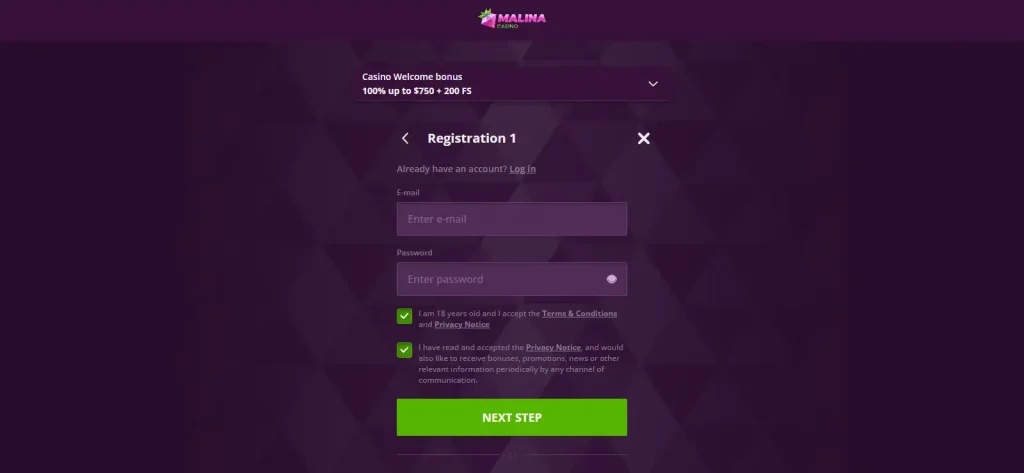
Table of Contents
- The visible registration flow starts before personal profile verification
- Age and account-identity rules come from the current Terms
- Creating the account does not complete Malina verification
- Registration data becomes ongoing account data
- A working AU registration route is not the same as Australian authorisation
- Account creation confirms a platform step, not a legal conclusion
- A practical registration checklist before the final decision
- The first registration screen is only the start of the account record
- What to check before creating a Malina account from Australia
Section element
Malina registration – Australia
The current Australia-facing Malina registration route begins with a choice about whether to use a welcome offer, including an option to continue without one. The account rules themselves sit in Malina’s Terms: users must be at least 18 and of the legal gambling age that applies to them, provide true and complete account information, and comply with the site’s one-account restrictions. Registration should not be confused with Australian authorisation. ACMA requested Australian ISPs block Malina Casino in October 2025 after finding the service in breach of the Interactive Gambling Act 2001.
Current entry screen
The visible registration flow starts before personal profile verification
The current public registration route first presents an offer-choice screen rather than exposing every later profile field in the crawlable page.
The Australia-facing registration page currently opens with a welcome-offer selection and an explicit choice to proceed without a welcome bonus. Later registration fields are not exposed on that same public page.
Registration interfaces can change more often than Terms, so old field lists can become outdated. The durable requirements are the ones Malina currently places in its Terms: correct personal details, one-account restrictions, minimum age, and later verification when requested.
The same Terms require account details to remain current when they change, so registration accuracy continues to matter after the account has been created.
The account therefore remains tied to the same personal details throughout later login, verification and withdrawal stages.
The broader Malina account guide maps registration to login, KYC, support and closure. Registration remains separate from later login, KYC, support and closure stages.
Section element
| Item | Current information |
|---|---|
| Age rule | 18+ and applicable legal age |
| Account identity | Own correct name |
| Information | True, complete and kept current |
| KYC | Separate later checks can apply |
Eligibility
Age and account-identity rules come from the current Terms
These requirements are more stable than the visual order of form fields.
Malina’s current General Terms state that a user may use the service only after reaching the legal age under the law applicable to them and must in all cases be at least 18. The responsible-gaming page repeats that registration for people under 18 is prohibited.
The Terms also require an account to be opened in the user’s own correct name and restrict duplicate accounts. Their wording limits accounts by person and also applies duplicate-account rules across household or address, phone or email, and IP address. Account information supplied during registration must be true and complete, and account details must be updated when they change.
Registration versus KYC
Creating the account does not complete Malina verification
Malina can request additional checks before or after deposits and around withdrawals.
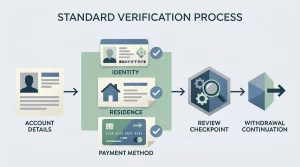
The current Terms allow Malina to request information needed to manage an account and verify identity or source of funds. They specifically describe checks of identity, age, residence and payment-method circumstances, and they allow KYC procedures before or after deposits and in connection with withdrawals.
That is the point where registration ends and verification begins. A user can understand the registration obligations without assuming that all identity checks happen on the first screen. The dedicated Malina verification page covers the current KYC evidence in more detail and should be used instead of repeating sensitive document and timing specifics here.
If the account later reaches a withdrawal stage, open verification checks can affect processing. That is another reason to keep registration and KYC as separate stages rather than treating account creation as the end of identity checks.
Login continuity
Registration data becomes ongoing account data
Once an account exists, the current login interface uses email and password, and the Terms require account details to remain current.
The current login page provides email and password fields plus a password-recovery route. That makes the email used during account setup an ongoing access credential rather than a disposable registration detail. Malina’s help centre says password recovery sends a reset message to the email address used during registration.
For readers who mainly use a phone, the Malina on mobile guide explains the browser-first access model. Mobile access does not change the identity, age or duplicate-account rules attached to the account itself.
Australian context
A working AU registration route is not the same as Australian authorisation
This distinction is central to reading the account process accurately.
Malina has an Australia-targeted English site and a current AU registration route. Those product facts do not establish a local licence. ACMA states that the Interactive Gambling Act makes it illegal for gambling providers to offer certain online services to people in Australia and lists online casinos among the banned services.
More specifically, ACMA announced on 15 October 2025 that it had requested Australian ISPs block Malina Casino after an investigation found the service operating in breach of the Interactive Gambling Act 2001. The dedicated Australian regulatory status page handles that record in full.
Registration access does not establish legal approval, local licensing or coverage by Australian wagering protections. Account setup and the Australian regulator position are separate questions.
What registration proves
Account creation confirms a platform step, not a legal conclusion
The safest interpretation is narrow: registration shows that the site presents an account-creation process, while regulatory status has to be checked independently.
This distinction is especially important when a site uses a country-specific path. A localized AU page can display Australian-dollar offers, English copy and an Australia-facing registration route without becoming an Australian-licensed online casino. Product localization is evidence about the website experience, not about the regulator’s approval.
The same logic applies after an account is created. Being able to log in, contact support or receive a KYC request describes how the service operates. None of those events changes ACMA’s published enforcement record. Keeping those categories separate makes the account guide more useful and avoids turning a technical process into a legal endorsement.
Before setup
A practical registration checklist before the final decision
The checklist keeps the account process focused on verified eligibility and data rules rather than promotional prompts.
| Check | Why it matters |
|---|---|
| Age | Malina requires at least 18 and any higher legal age that applies to the user. |
| Account details | The Terms require true, complete information in the user’s own correct name. |
| Duplicate accounts | The current Terms contain one-account and duplicate-account restrictions. |
| Verification | KYC can occur separately after account setup and can affect later transactions. |
| Australian status | ACMA’s enforcement record must be considered separately from the existence of the AU registration route. |
A useful setup check also includes the email address that will be used for future login and password recovery, because access continuity depends on information remaining accurate and available to the account holder.
Account continuity
The first registration screen is only the start of the account record
The visible AU entry stage is brief, but the Terms make accuracy and continuity important after that first screen.
The current AU route begins with a welcome-offer choice and includes a clear option to continue without a welcome bonus. That is the public stage that can be verified today. It should not be expanded into a guessed list of later form fields. The durable rules come from the Terms: the account must be in the user’s own correct name, registration information must be true and complete, and account details must be kept current.
Those rules continue after registration. The current login interface uses email and password and includes password recovery, so the credentials attached to setup remain part of later account access. Malina also applies one-account and duplicate-account restrictions. That makes consistency more important than speed: changing identity details, using alternate credentials or treating a second profile as a workaround can conflict with the account rules.
KYC is the next separate stage rather than an extension of the first form. Malina can later check identity, age, residence, payment-method ownership and source of funds. Registration therefore creates the account record; later verification can test whether that record and the financial activity attached to it are consistent.
Registration takeaway
What to check before creating a Malina account from Australia
The final account decision should use both the platform rules and the separate Australian regulatory record.
The main Malina Australia guide connects registration with payments, games, mobile access and trust coverage. For registration itself, use only the current process that can be verified, keep account details accurate and understand that KYC can follow later. The existence of an Australia-facing registration route does not establish Australian licensing or approval. ACMA’s published enforcement action remains a separate fact that should be considered alongside the account process.